
Duolingo: Inside the Business Behind the World’s Most Popular Language App
From a free language-learning app to a billion-dollar public company, Duolingo has become one of the most fascinating consumer-tech success stories of the modern era.
With tens of millions of people opening the app every day, Duolingo isn’t just teaching languages anymore—it’s demonstrating how habit loops, gamification, and freemium economics can create one of the most successful mobile businesses in the world.
Whether you’re building an app, planning a content business, or simply curious about how a “free” product generates serious revenue, Duolingo is a case study worth studying.
In this guide, we’ll explore:
- Duolingo’s latest business numbers
- How the company actually makes money
- Why its engagement strategy works
- What it would take to build something similar today
- Where new competitors can still find opportunities
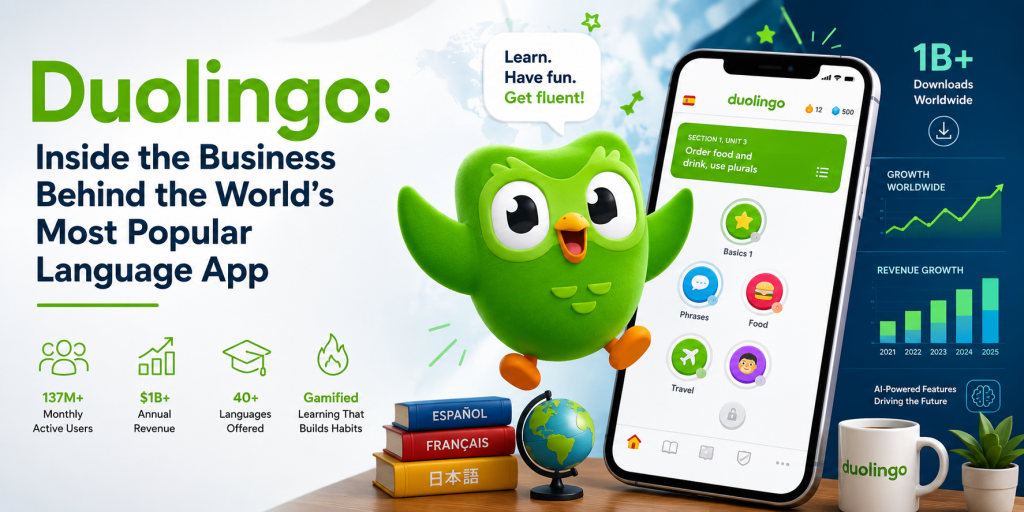
Duolingo by the Numbers (2026)
Duolingo continues to grow rapidly, even while intentionally sacrificing some short-term financial growth to invest more heavily in product improvements and user acquisition.
| Metric | Value |
|---|---|
| Daily Active Users (DAU) | 56.5 Million |
| Monthly Active Users (MAU) | 137.8 Million |
| Paid Subscribers | 12.5 Million |
| Q1 2026 Revenue | $292.0 Million |
| FY2025 Revenue | ~$1.04 Billion |
| FY2025 Bookings | ~$1.16 Billion |
| Subscription Revenue Share | ~86% of Revenue |
| Paid Conversion Rate | ~9.1% of MAUs |
| Total Downloads | 1 Billion+ |
| Languages Supported | 40+ |
| Total Courses | 280+ |
Key Takeaways
A few numbers stand out immediately:
✅ Duolingo’s goal is to reach 100 million daily active users by 2028.
✅ Management is intentionally prioritizing long-term user growth over maximizing near-term profits.
✅ International markets—including India, Brazil, Vietnam, and Mexico—are now major growth drivers.
✅ Despite having over 137 million monthly users, more than 90% still use the free version.
That last point is particularly important because it explains almost everything about Duolingo’s business strategy.
The Business Model: How a Free App Makes Billions
Duolingo operates one of the world’s most successful scaled freemium models.
Its business isn’t built around forcing users to subscribe. Instead, the company has designed multiple revenue streams that monetize both free and paid users.
1. The Free Tier: More Than a Funnel
Most people assume the free version simply exists to convert users into subscribers.
That’s only partially true.
The free version also generates money directly through:
- Advertising
- One-time in-app purchases
- User acquisition data
- Brand growth and network effects
Q1 2026 Revenue from Free Users
| Revenue Source | Amount |
|---|---|
| Advertising | $20.6 Million |
| In-App Purchases | $8.4 Million |
Free users are therefore not just a conversion funnel.
They are an entire business line on their own.
This is why Duolingo can afford to keep its core experience genuinely free while still remaining highly profitable.
2. Subscriptions: The Real Revenue Engine
Subscriptions are where most of the money comes from.
Q1 2026 Subscription Revenue
$250.9 Million
≈86% of Total Revenue
Duolingo currently offers two primary subscription products.
Super Duolingo
Features include:
- Ad-free experience
- Unlimited hearts (lives)
- Personalized practice sessions
- Progress tracking tools
Duolingo Max
The premium AI tier includes:
- Roleplay conversations
- Explain My Answer
- AI-powered Video Calls
- Interactive speaking practice
Why This Pricing Strategy Works
Duolingo uses a classic:
Good → Better → Best
pricing structure.
| Tier | Target User |
|---|---|
| Free | Casual learners |
| Super | Regular learners |
| Max | Power users seeking AI tutoring |
This structure allows Duolingo to increase revenue per user without necessarily increasing downloads.
3. The Duolingo English Test (DET)
This is arguably the most underrated part of the business.
The Duolingo English Test (DET) is an English certification exam used for:
- University admissions
- Visa applications
- Immigration processes
Q1 2026 DET Revenue
$11.3 Million
Adoption Numbers
- Accepted by 6,100+ education programs
- Accepted by all 8 Ivy League universities
- Accepted by 24 of the top 25 US undergraduate programs for international students
- Accepted by 3,100+ US universities
- Accepted by 6,000+ institutions globally
Why DET Matters
DET transforms Duolingo from a simple consumer app into a company that also participates in:
- Education technology
- Certification services
- Higher education admissions
- International student mobility
Credentialing businesses generally have:
- Higher willingness to pay
- Lower price sensitivity
- More defensible economics
This diversification significantly strengthens Duolingo’s business model.
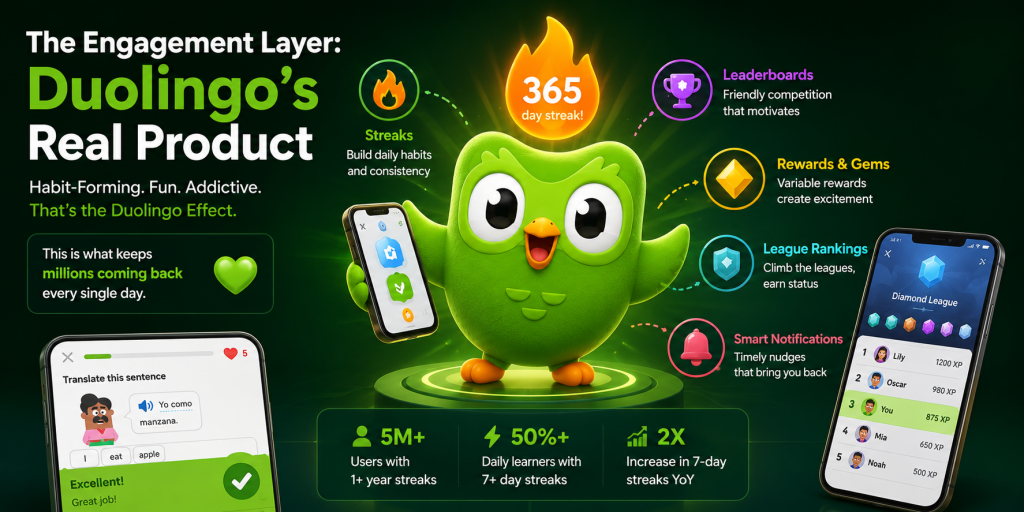
4. The Engagement Layer: Duolingo’s Real Product
The monetization engine only works because users keep coming back.
And that’s where Duolingo truly excels.
Engagement Metrics
- 5+ million users have streaks lasting one year or longer
- More than half of daily learners maintain streaks of at least seven days
- Seven-day streak adoption has doubled year-over-year
Core Retention Mechanics
🔥 Streaks
Encourages daily usage.
🏆 Leaderboards
Creates competition.
💎 Rewards and Gems
Provides variable rewards.
📈 League Rankings
Introduces social status and progression.
🦉 Notifications
Uses humor and guilt to encourage users to return.
These aren’t decorative features.
They are the retention infrastructure that powers the entire business.
Who Uses Duolingo?
The platform’s audience is heavily concentrated among younger, mobile-first users.
Audience Breakdown
- Approximately 60% of daily users are aged 16–34
- Around 60% of US users are under 30
- Ages 18–24 represent the largest user segment
This demographic explains why:
- Gamification performs exceptionally well
- Short sessions outperform long lessons
- Mobile-first design dominates engagement
Duolingo famously optimizes for:
“A few minutes a day.”
That philosophy has become one of its biggest competitive advantages.
Most Studied Languages in 2025
- English
- Spanish
- French
- Japanese
- German
- Korean
- Italian
- Chinese
- Portuguese
- Hindi
Interestingly:
- Japanese surpassed German globally
- Korean overtook Italian
Much of this growth appears driven by:
- Anime
- K-pop
- Asian entertainment
- Cultural globalization
How Would You Build a Business Like Duolingo Today?
Trying to replicate today’s Duolingo directly would be extremely difficult.
A better strategy is to attack a specific niche.
Phase 1: Pick a Wedge
Avoid building another general language-learning platform.
Instead, focus on underserved segments.
Opportunities
✅ Business communication training
✅ Industry-specific language learning
✅ Conversation-first language apps
✅ Test-preparation products
✅ Regional language pairs with limited resources
Example Ideas
- Spanish for healthcare workers
- Japanese for anime fans
- English for software engineers
- Mandarin for business professionals
Phase 2: Build Engagement Before Content
Most startups get this backward.
They spend years building content libraries before validating retention.
Duolingo proves that:
Habit > Content Depth
Start by testing:
- Daily streaks
- Rewards
- Push notifications
- Leaderboards
- Social competition
If users don’t return every day, adding more lessons won’t solve the problem.
Phase 3: Monetize Early
Relying entirely on subscriptions is risky.
A better approach is a diversified revenue model.
Potential Revenue Streams
- Advertising
- One-time purchases
- Premium subscriptions
- B2B partnerships
- Certification products
- Enterprise training solutions
Multiple monetization levers create resilience.
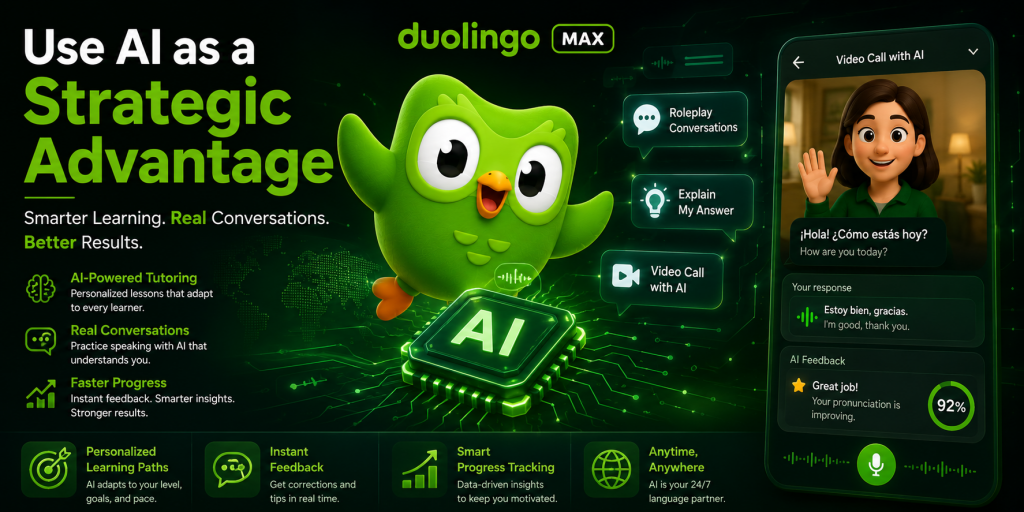
Phase 4: Use AI as a Strategic Advantage
AI should not simply generate lessons.
It should function as a learning partner.
Areas Where AI Can Win
- Real-time conversations
- Pronunciation feedback
- Personalized lesson paths
- Scenario-based simulations
- Adaptive tutoring
Examples:
- Medical Spanish tutor
- Business Mandarin coach
- English interview preparation
- Customer support communication training
A focused AI product can outperform broader solutions for specific audiences.
What It Takes to Actually Compete
Duolingo’s biggest advantages are:
- Massive brand recognition
- Engagement expertise
- Data scale
- User behavior insights
Its moat is not exclusive content.
It’s the enormous amount of behavioral data generated by hundreds of millions of users.
The Good News for Startups
You don’t need 100 million users.
You need the right users.
Winning a highly specific niche can build a substantial business.
Practical Lessons for New Entrants
🎯 Niche Aggressively
Position around an outcome, not a category.
🔥 Design for Retention
Build habits before content libraries.
💰 Diversify Monetization
Don’t depend entirely on subscriptions.
🤖 Use AI Meaningfully
Create specialized conversation experiences.
🌎 Think Internationally
Local pricing and payment methods can become major advantages.
The Bigger Lesson
Duolingo’s story isn’t really about language learning.
It’s about building a genuinely useful free product and designing systems that make people want to come back every day.
The formula is surprisingly simple:
Give away the core experience.
Make the free product valuable enough to retain users.
Monetize through multiple revenue streams.
Reserve premium pricing for users who want more depth, AI capabilities, or high-value credentials.
For entrepreneurs, the opportunity isn’t beating Duolingo head-on.
The opportunity is finding the audience, language pair, or learning outcome that Duolingo’s broad strategy hasn’t fully served—and building a product that serves that niche exceptionally well.