
How Duolingo transformed a free language-learning app into a billion-dollar public company—and what founders can learn from its business model.
When people think of Duolingo, they usually think of the green owl reminding them to complete today’s lesson.
But behind that playful mascot is one of the most successful consumer technology businesses of the past decade.
Duolingo has proven that education doesn’t have to be boring—or expensive—to become a global business. Through a combination of gamification, behavioral psychology, artificial intelligence, and a carefully designed freemium model, the company has grown into a $1+ billion annual revenue business while remaining one of the world’s most downloaded education apps.
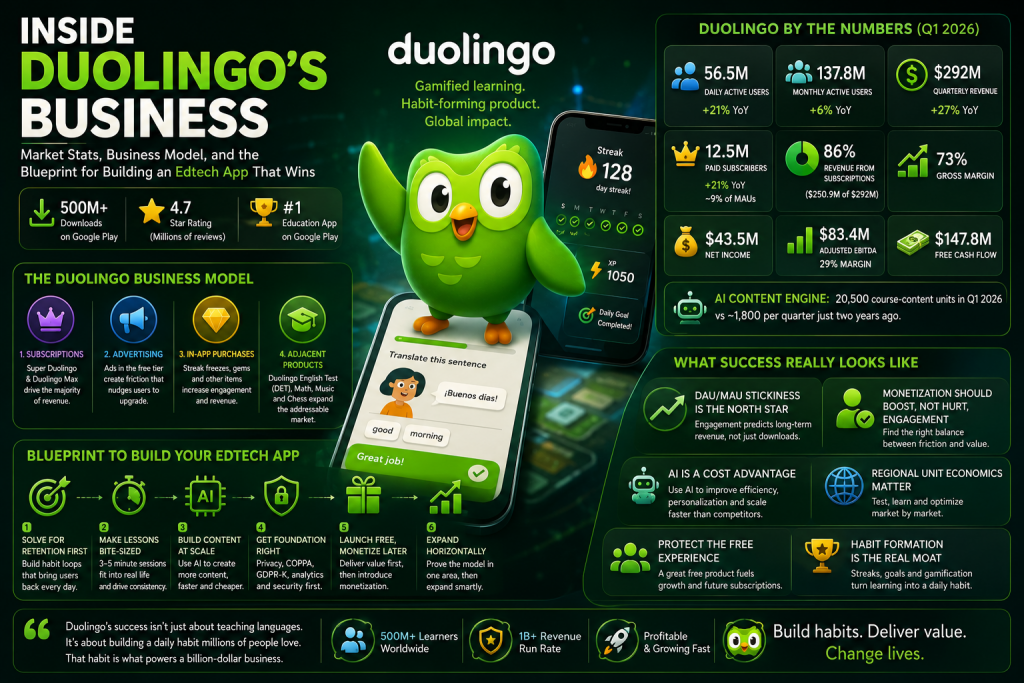
With 500+ million downloads on Google Play, a 4.7-star rating, and millions of users learning every day, Duolingo has become a blueprint for modern EdTech.
Let’s break down the numbers, the business model, and what it actually takes to build a company like this.
Duolingo by the Numbers (2026)
Unlike many startups, Duolingo is a publicly traded company, meaning it reports detailed financial results every quarter.
Its latest numbers show a business that is still growing rapidly while becoming increasingly profitable.
User Growth
Duolingo reported:
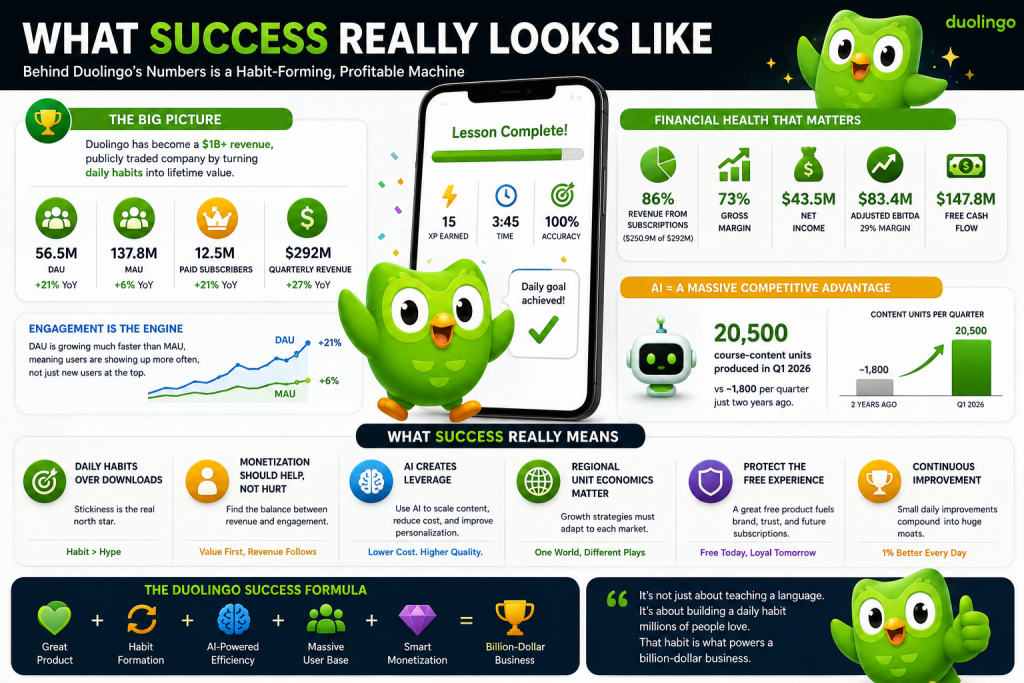
- 56.5 million Daily Active Users (DAUs)
- 137.8 million Monthly Active Users (MAUs)
- 21% year-over-year DAU growth
- Approximately 6% year-over-year MAU growth
One interesting insight is that daily usage is growing much faster than monthly usage.
That means existing users aren’t just downloading the app—they’re returning more frequently.
For a habit-based product, that’s a powerful signal.
Revenue Growth
Financial performance has been equally impressive.
Recent results include:
- $292 million quarterly revenue
- 27% year-over-year revenue growth
- More than $1 billion in annual revenue during 2025
- 73% gross margin
- $43.5 million net income
- $83.4 million Adjusted EBITDA
- $147.8 million free cash flow
This isn’t simply a fast-growing startup anymore.
It’s a profitable software business.
Paid Subscribers
Duolingo now has:
- 12.5 million paid subscribers
- Around 21% year-over-year subscriber growth
- Approximately 9% conversion from MAU to paid users
Only a small percentage of users pay.
Yet that small percentage generates almost all of the company’s revenue.
Subscription Revenue Dominates
One of the biggest misconceptions about Duolingo is that advertising is its primary business.
It isn’t.
Approximately:
- 86% of total revenue comes from subscriptions
- Advertising contributes only a relatively small share
- Premium subscriptions remain the core revenue engine
This is an important lesson for every SaaS and EdTech founder.
The free version attracts users.
The subscription business creates the company.
AI Has Become a Competitive Advantage
Artificial intelligence isn’t simply a feature inside Duolingo anymore.
It’s part of the company’s operating system.
In Q1 2026, Duolingo produced approximately:
- 20,500 course-content units
Just two years earlier, it was producing roughly:
- 1,800 units per quarter
That represents an enormous improvement in content production efficiency.
Instead of replacing teachers, AI is helping Duolingo create educational content dramatically faster than before.
The Mobile Education Market
Duolingo sits at the intersection of several fast-growing industries:
- Mobile learning
- Consumer subscriptions
- Artificial intelligence
- Gamification
- Digital education
Demand continues to rise as more people learn online, study for exams remotely, and develop professional skills through mobile apps.
Unlike traditional education companies, Duolingo can scale globally with relatively low distribution costs.
Every additional learner costs far less than opening another classroom.
How Duolingo Makes Money
At first glance, Duolingo feels completely free.
Behind the scenes, however, it operates a highly optimized freemium business.
Let’s break down each revenue stream.
1. Premium Subscriptions
Subscriptions are the heart of Duolingo’s business.
The company offers multiple premium tiers.
Super Duolingo
Subscribers receive:
- Unlimited Hearts
- No advertisements
- Streak repair
- Faster progress
- Offline learning
Duolingo Max
The premium AI-powered tier includes features like:
- AI conversations
- Personalized explanations
- Interactive learning assistance
These subscription products generate the majority of company revenue.
2. Advertising
Free users watch advertisements between lessons.
However, the ads serve two purposes:
- Generate advertising revenue
- Encourage users to upgrade
Finding the right balance is critical.
Too many ads hurt retention.
Too few reduce monetization.
Duolingo constantly experiments to find the optimal balance.
3. In-App Purchases
The app also monetizes through virtual goods, including:
- Gems
- Streak freezes
- Hearts
- Power-ups
- Special rewards
These purchases borrow proven mechanics from mobile gaming.
Instead of forcing subscriptions immediately, they gradually increase engagement.
4. Adjacent Products
Duolingo has expanded beyond language learning.
Today its ecosystem includes:
- Duolingo English Test (DET)
- Math
- Music
- Chess
Rather than creating completely new businesses, Duolingo reused its existing:
- Gamification engine
- User base
- Brand
- Content infrastructure
This significantly lowered expansion costs.
The Secret Product Isn’t Language Learning
Many people think Duolingo sells language education.
In reality, its biggest product is habit formation.
Everything inside the app encourages daily engagement:
- Streaks
- XP points
- Daily goals
- Leaderboards
- Achievement badges
- Push notifications
- The famous green owl reminders
These systems create a routine.
And routines create long-term subscribers.
What It Would Take to Build an App Like Duolingo
Building an educational app today is much easier technically than it was ten years ago.
Building a business like Duolingo is much harder.
Here’s what founders should focus on.
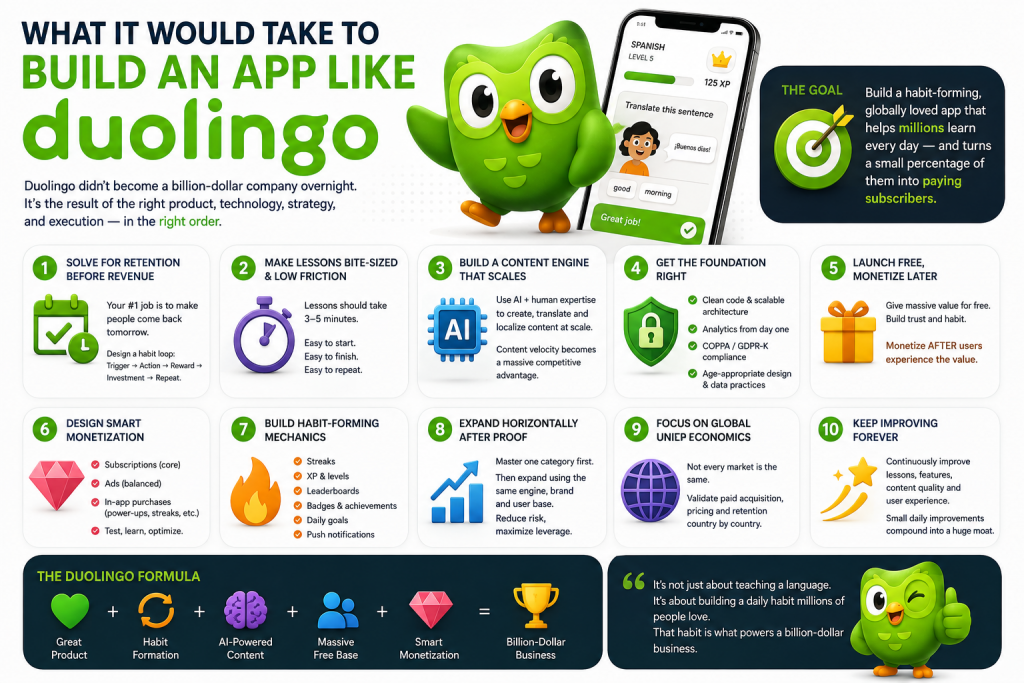
1. Build Retention Before Revenue
Many startups think about monetization too early.
Duolingo first solved one problem:
Getting people to return tomorrow.
If users don’t build a habit, subscriptions won’t matter.
Retention comes first.
Revenue comes second.
2. Keep Learning Sessions Short
One reason Duolingo works so well is that lessons take only a few minutes.
Small wins create momentum.
Users think:
“I have five minutes.”
Instead of:
“I need an hour.”
That dramatically increases daily engagement.
3. Scale Content Efficiently
Educational businesses eventually become content businesses.
Without efficient production systems, growth slows.
Duolingo invested heavily in AI to:
- Create lessons faster
- Translate content
- Personalize exercises
- Reduce production costs
The result is a significant competitive advantage.
4. Build the Right Foundation
Successful EdTech products require more than good design.
They also need:
- Privacy compliance
- Child safety protections
- Analytics infrastructure
- Reliable cloud architecture
- Scalable databases
These decisions are expensive to fix later.
Build them correctly from the beginning.
5. Launch Free
One reason Duolingo grew so quickly is that anyone could start learning immediately.
The free experience was genuinely useful.
Only after users experienced value did monetization become important.
That’s a much stronger acquisition strategy than asking users to pay upfront.
6. Expand Only After Winning One Market
Duolingo didn’t launch with languages, math, music, chess, and test preparation simultaneously.
It dominated one category first.
Only then did it expand into adjacent markets.
This reduced risk while maximizing reuse of existing technology.
What Success Really Looks Like
Duolingo teaches several lessons that apply far beyond education.
Daily Usage Matters More Than Downloads
Downloads create headlines.
Daily active users create businesses.
The companies that survive are those people use every day.
Monetization Should Never Hurt Engagement
Every advertisement, subscription prompt, or paywall introduces friction.
The challenge is increasing revenue without reducing user satisfaction.
Duolingo continuously experiments to maintain that balance.
AI Should Reduce Costs
Many companies add AI simply because it’s trendy.
Duolingo uses AI to:
- Produce more lessons
- Lower content costs
- Improve personalization
- Increase operational efficiency
That’s a competitive advantage competitors struggle to replicate.
Regional Strategies Matter
Not every country behaves the same.
Pricing…
Marketing…
User acquisition…
Retention…
Payment preferences…
All differ across regions.
Duolingo adjusts its strategy market by market instead of assuming one global formula.
Protect the Free Experience
Ironically, the free version may be Duolingo’s most valuable product.
It fuels:
- Word-of-mouth growth
- Brand awareness
- Organic acquisition
- Future subscriptions
That’s why the company carefully manages advertising instead of maximizing short-term ad revenue.
Lessons Every Product Builder Can Learn
Whether you’re building an EdTech platform, SaaS product, fitness app, or AI tool, Duolingo demonstrates several universal principles:
- Build habits before monetization.
- Keep onboarding friction extremely low.
- Focus on retention over downloads.
- Design products around daily engagement.
- Use AI to improve operations—not just marketing.
- Expand into adjacent markets only after mastering one.
- Let subscriptions grow naturally from product value.
These lessons apply to almost every successful consumer software company today.
Final Thoughts
Duolingo didn’t become a billion-dollar company simply by teaching languages.
It built one of the world’s strongest habit-forming digital products.
Its success comes from combining psychology, gamification, artificial intelligence, subscriptions, and continuous product optimization into a business that keeps users returning every single day.
For entrepreneurs, the biggest takeaway isn’t to copy Duolingo’s features.
It’s to copy its sequence:
- Build an irresistible daily habit.
- Earn long-term user trust.
- Create operational advantages through technology.
- Scale content efficiently.
- Introduce monetization without damaging engagement.
- Expand only after your core engine consistently works.
That’s the blueprint that turned a free language-learning app into one of the world’s most successful EdTech companies.